
Using Everyday Cooking to Teach Chemistry Concepts to Kids
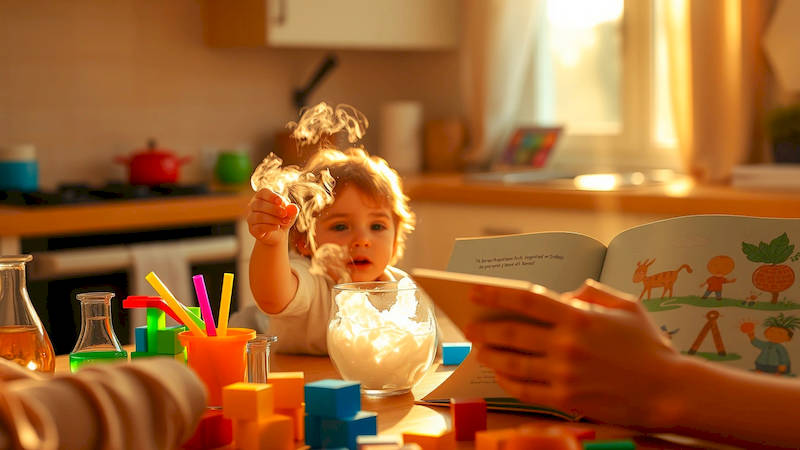
Cooking, often viewed as a simple necessity or a creative outlet, is actually a fascinating, hands-on laboratory brimming with chemistry. For children, the kitchen provides a uniquely engaging environment to learn complex scientific concepts in a tangible, edible way. Rather than abstract formulas and textbook definitions, cooking allows kids to see, smell, taste, and experience chemistry in action. This article will explore how parents and educators can leverage everyday cooking activities to introduce and reinforce core chemistry principles, fostering a love for STEM and building a strong foundation for future learning. Successfully integrating these lessons requires understanding not just the ‘how’ of cooking, but also the ‘why’ – the underlying chemical reactions at play.
The benefits extend far beyond simply understanding science. Cooking promotes valuable life skills like math (measuring), following directions, problem-solving (adjusting recipes), and teamwork. It also encourages healthy eating habits and an appreciation for where food comes from. In a world increasingly focused on STEM careers, laying the groundwork early through relatable experiences is crucial. According to the U.S. Bureau of Labor Statistics, STEM occupations are growing at a faster rate than the average for all occupations, highlighting the importance of fostering interest in these fields from a young age.
- The Magic of Maillard Reaction: Browning and Flavor Development
- Acids, Bases, and Baking: Leavening Agents in Action
- Emulsions and Suspensions: The Science of Mixing
- States of Matter and Phase Changes: From Solid to Steamed
- Controlling Reactions: Temperature and Time
- The Role of Salts: Enhancing Flavor and Preserving Food
- Conclusion: A Recipe for Scientific Curiosity
The Magic of Maillard Reaction: Browning and Flavor Development
The appealing browning we see when searing a steak, baking bread, or roasting vegetables isn’t just about aesthetics; it's a prime example of the Maillard reaction, a complex chemical process between amino acids and reducing sugars. This non-enzymatic browning is responsible for the delicious flavors and aromas that make cooked food so tempting. Explaining this to children doesn’t require complex biochemistry. Start by simply observing – what happens when you toast bread versus leaving it untoasted? What about the difference in color and aroma when sautéing onions?
This provides an excellent opportunity to discuss how heat influences chemical reactions. You can demonstrate this further by comparing the color of a raw potato slice to one that has been fried; the change isn't merely a physical change in color, but a result of chemical compounds forming due to heat. Encourage kids to describe the changes they observe – the color, smell, and even the texture – and connect these observations to the idea of “something new” being created during cooking. It’s a fantastic illustration of how energy (heat) drives chemical transformations.
Finally, the Maillard reaction isn’t a single reaction but a cascade of many, resulting in hundreds of different flavor compounds. This highlights the complexity of even seemingly simple processes, demonstrating that science isn’t always about finding straightforward answers but often exploring intricate systems.
Acids, Bases, and Baking: Leavening Agents in Action
Baking provides a perfect playground for exploring acids and bases. Many baking recipes rely on a chemical reaction between an acidic ingredient and a base to create carbon dioxide gas, which leavens the baked goods, making them light and fluffy. Common examples include baking soda (sodium bicarbonate – a base) reacting with an acid like buttermilk, vinegar, or lemon juice. Baking powder, a complete leavening agent, contains both an acid and a base, which react when moistened.
To demonstrate this, a simple experiment can be undertaken: combine baking soda and vinegar in a dish and observe the fizzing reaction – this is the carbon dioxide gas being released. Explain that this same gas is what makes cakes rise. You can also compare recipes that use baking soda with those that use baking powder and discuss how the different acids affect the flavor and texture. For older children, you can introduce the pH scale as a way to measure acidity and alkalinity, relating it back to the ingredients they’re using.
The importance of the correct balance cannot be overstated. Too much acid or base will impact the final product, providing a real-world example of the necessity for precision and the consequences of imbalance in chemical reactions. Consider how adding too much baking soda might create a soapy taste versus too little resulting in a flat result.
Emulsions and Suspensions: The Science of Mixing
Many of our favorite foods – mayonnaise, salad dressings, sauces, and even milk – are either emulsions or suspensions. An emulsion is a mixture of two liquids that don't naturally combine, such as oil and water, stabilized by an emulsifier. Common emulsifiers include egg yolks (in mayonnaise) and mustard. A suspension is a mixture where solid particles are dispersed in a liquid but will eventually settle out, like chocolate milk or Italian dressing.
Demonstrate the concept of emulsions by attempting to mix oil and water. Observe how they separate quickly. Then, introduce an emulsifier – like a little bit of mustard – and whisk vigorously. Watch as the oil and water form a stable mixture. Explain that the emulsifier essentially acts as a bridge, allowing the two liquids to interact.
Exploring suspensions is equally revealing. Make a simple Italian dressing with oil, vinegar, and herbs, then observe how the herbs settle over time. Discuss why this happens—the herbs are heavier and don’t stay evenly dispersed in the liquid. This illustrates the concept of density and how it influences the stability of mixtures, introducing basic physics principles alongside the chemistry.
States of Matter and Phase Changes: From Solid to Steamed
Cooking involves constant changes in the state of matter. Water, a key ingredient in most recipes, exists as a solid (ice), a liquid (water), and a gas (steam). When you boil water, you're observing a phase change from liquid to gas – evaporation – driven by the addition of heat energy. Melting butter, freezing ice cream, and even caramelizing sugar all demonstrate different phase changes.
Introduce this concept by explaining how adding or removing heat alters the arrangement and movement of molecules. A simple demonstration would be to observe ice melting (solid to liquid) and then boiling (liquid to gas). Discuss how the molecules are moving faster and further apart as they transition between states. It’s important to emphasize that the substance doesn’t disappear during a phase change; it only changes its form.
Furthermore, introduce the concept of sublimation - when a solid turns directly into a gas - by discussing dry ice, if access is possible safely. Observing this transformation allows children to understand that not all phase changes involve an intermediate liquid phase.
Controlling Reactions: Temperature and Time
Controlling the rate of chemical reactions is at the heart of cooking. Temperature and time play critical roles in how quickly reactions occur. The higher the temperature, generally, the faster the reaction (though there are exceptions). This is why recipes specify cooking times and temperatures.
Experiment with this by comparing the speed of browning a marshmallow over a low flame versus a high flame. Discuss how temperature influences the Maillard reaction. You can also demonstrate the effect of time by allowing dough to rise at different temperatures – a warmer environment will result in faster yeast activity. Explore the concept of enzyme activity as well, discussing how heat can denature (break down) enzymes in food, impacting texture and flavor.
Encourage experimentation (within safe limits, of course). Letting kids adjust cooking times or temperatures (with supervision) and observing the results can solidify their understanding of these concepts. For instance, slightly underbaking a cookie versus overbaking it provides a clear visual and textural example of how time affects the outcome.
The Role of Salts: Enhancing Flavor and Preserving Food
Salt isn't just about making food taste good; it plays a crucial role in chemical processes, impacting everything from flavor perception to texture and preservation. Salt enhances flavor by interacting with taste receptors on the tongue, and it affects the texture of food by interacting with proteins. Historically, salt was used as a preservative because it draws water out of cells, inhibiting the growth of bacteria.
Demonstrate salt’s impact on protein structure by comparing the texture of meat that has been brined (soaked in salt water) to unbrined meat. Brining helps break down proteins, resulting in a more tender and juicy final product. Discuss how salt helps to draw out moisture from vegetables which prevents them from wilting or losing their crispness. You could also perform a simple experiment by comparing how quickly bread molds with and without a small amount of salt added to the dough.
Moreover, explaining the concept of osmosis – the movement of water across a semi-permeable membrane – provides a scientific foundation for understanding salt’s preservative properties.
Conclusion: A Recipe for Scientific Curiosity
Using everyday cooking as a gateway to chemistry education is a powerful approach to fostering a lifelong love of STEM learning. By moving beyond abstract concepts and engaging children in hands-on exploration within the familiar environment of the kitchen, we can demystify science and reveal its relevance to their everyday lives. The key takeaways are that chemistry is everywhere, that experimentation (with safety precautions) is essential for learning, and that understanding the “why” behind cooking processes unlocks a deeper appreciation for both science and food.
Encourage children to ask questions, make observations, and experiment with recipes. Keep a “kitchen science journal” to record observations and results. Explore online resources and age-appropriate books about the science of cooking. By embracing the opportunity to turn the kitchen into a laboratory, we can empower the next generation of scientists, chefs, and innovators, one delicious experiment at a time. Regularly incorporate these types of activities into family routines to solidify understanding and create a chemical curiosity that will last a lifetime.
Deja una respuesta