
Effective Strategies for Encouraging Independent Problem Solving in Toddlers
Toddlerhood is a period of incredible neurological development, a time when foundations for lifelong learning and adaptation are laid. While it’s natural to rush in and solve problems for our little ones, constantly doing so inadvertently hinders the development of crucial problem-solving skills. Encouraging independent problem-solving isn’t about letting toddlers struggle endlessly; it’s about providing a supportive environment where they can learn to navigate challenges, build confidence, and develop resilience. This skill isn’t simply about finding answers; it's about the process of how they attempt to find those answers - a process that lays the groundwork for academic success, social competency, and emotional regulation.
Many parents unknowingly fall into the “rescue” pattern, driven by a desire to protect their child from frustration. However, experiencing and overcoming minor frustrations is a vital part of cognitive development. A child who rarely encounters – and resolves – obstacles may grow up lacking in self-efficacy and the ability to cope with adversity. In fact, research shows a strong correlation between early problem-solving skills and later success in school and life. This article offers practical, research-backed strategies to help you nurture your toddler’s blossoming ability to tackle challenges independently, turning everyday moments into valuable learning opportunities.
- Creating a Problem-Solving Environment
- The Power of "Pause" and Resist the Rescue
- Focusing on the Process, Not Just the Outcome
- Scaffolding Support: Providing Just Enough Help
- Modeling Problem-Solving Behavior
- Embracing Play-Based Learning: Games and Activities
- Conclusion: Nurturing a Confident, Capable Learner
Creating a Problem-Solving Environment
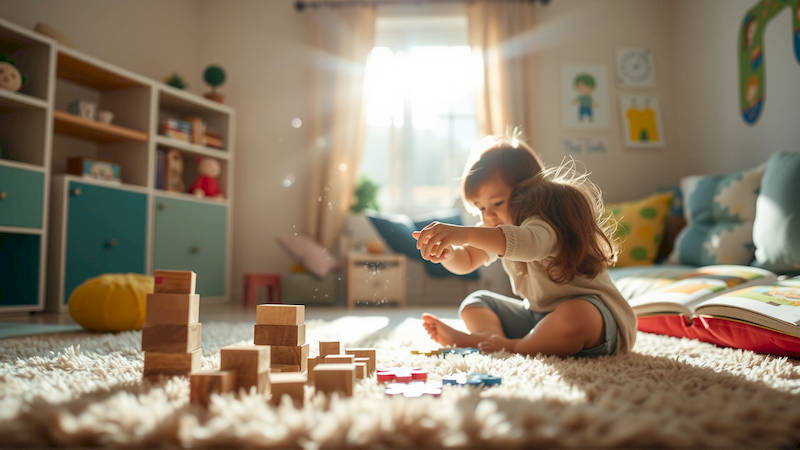
The physical environment plays a significant role in fostering independent problem-solving. This doesn't require a complete overhaul of your home; rather, it involves making thoughtful adjustments to encourage exploration and provide opportunities for your toddler to grapple with challenges. Think about accessibility. Can your toddler reach their toys, books, and art supplies, or are they constantly asking for assistance? Low shelves, accessible storage containers, and designated “exploration zones” are excellent starting points. Organize items in a way that allows for some level of complexity – a basket of mixed-size blocks, for example, presents a problem-solving opportunity in building.
Beyond physical accessibility, consider the “stage” you set for activities. Instead of constructing a tower for your toddler, present them with the blocks and a challenge – "Can you build a tower as tall as your knee?" This subtly shifts the focus from you providing the solution to them finding it. Avoid over-stimulating environments filled with too many toys; a curated selection allows for deeper engagement and reduces overwhelm, enabling more focused problem-solving. Remember, the goal is to create a space that invites exploration, experimentation, and a healthy level of challenge.
Finally, embrace mess! A certain degree of mess is inevitable when a toddler is engaged in exploratory play. Resisting the urge to immediately clean up or “fix” their creations allows them to see projects through to completion (or glorious, messy failure!) and learn from the experience. This isn’t about abandoning cleanliness entirely but about prioritizing the learning process over pristine order in designated play areas.
The Power of "Pause" and Resist the Rescue
The most impactful strategy you can employ is often the hardest: pausing before intervening. That immediate instinct to jump in and "fix" a problem for your toddler? Consciously resist it. When your child is struggling, take a moment to observe what they’re attempting, how they’re approaching the challenge, and where they’re getting stuck. This pause allows you to assess whether they genuinely need your help or if they’re simply experiencing frustration – a perfectly normal and valuable part of learning. Often, simply providing a little extra time is enough for them to find a solution on their own.
Instead of directly solving the problem, try asking open-ended questions. “What are you trying to do?” “What’s happening?” “Is that working? What else could you try?” These questions prompt your toddler to articulate the problem (which itself is a critical thinking skill) and explore potential solutions. Avoid leading questions like, “Did you try turning it over?” Instead, focus on eliciting their own observations and ideas. “Hmm, it’s not fitting. What do you think we could do?” This approach transforms you from a problem-solver into a facilitator, guiding their thinking without doing the work for them.
Remember, the goal isn’t to avoid ever helping, but to delay assistance strategically. As Dr. Laura Markham, author of Peaceful Parent, Happy Kids, emphasizes, "Resisting the urge to rescue teaches children that they are capable and can handle challenges." Start with smaller frustrations and gradually increase the complexity as your toddler gains confidence.
Focusing on the Process, Not Just the Outcome
It’s easy to get caught up in the result – did they build the tower, complete the puzzle, fit the shape in the slot? However, true learning lies in the process, the thinking, experimenting, and problem-solving that occurs along the way. When praising your toddler, shift your focus from the outcome to the effort and strategies they employed. Instead of saying, “Great job building a tall tower!” try “I noticed you tried different ways to stack the blocks to make it stable. That was very clever!”
This type of praise validates their thinking process and encourages persistence. Similarly, if they don't succeed, avoid statements like, "That's okay, let me do it." Instead, acknowledge their effort and encourage further exploration. “That didn’t work this time. What could you try differently?” Emphasize that making mistakes is an essential part of learning. Frame failures as opportunities for growth, not as setbacks.
Consider creating a “mistake jar” where you and your toddler can collectively acknowledge and discuss “learning moments” – times when something didn’t go as planned, and what was learned from the experience. The key is to foster a growth mindset – the belief that abilities can be developed through dedication and hard work – rather than a fixed mindset that emphasizes innate talent. When your child understands that effort and experimentation are valued, they will be more willing to embrace challenges and persevere through difficulties.
Scaffolding Support: Providing Just Enough Help
“Scaffolding” is a pedagogical technique where you provide temporary support to help a child master a task, gradually reducing assistance as they become more competent. In the context of problem-solving, this means offering just enough help to get your toddler back on track without taking over completely. If your toddler is struggling to put a puzzle piece in, for example, don't simply force it in. Instead, you might say, “Look closely at the shape of the piece and the opening. Do you see anything that matches?”
This provides a gentle cue, guiding their attention to the relevant features without explicitly providing the solution. You might also physically assist, but only to initiate the action, allowing them to complete it. For instance, you could slightly rotate the puzzle piece so it's closer to the correct orientation, then let your toddler finish the placement. The goal is to provide a “boost” that enables them to successfully navigate the challenge, building confidence and self-reliance.
The amount of scaffolding should be tailored to your toddler’s individual needs and abilities. Observe their level of frustration and adjust your support accordingly. As they become more proficient, gradually reduce the amount of assistance you provide, allowing them to take on increasing responsibility for finding solutions.
Modeling Problem-Solving Behavior
Toddlers are masterful imitators. They learn by observing the behaviors of those around them, especially their parents and caregivers. Therefore, one of the most powerful ways to encourage independent problem-solving is to model it yourself. When you encounter a challenge in front of your toddler, verbalize your thought process. "Hmm, this lid is stuck. Let me try twisting it a little harder. Okay, that didn't work. Maybe if I run it under warm water…"
By openly narrating your problem-solving steps, you demonstrate a positive and constructive approach to challenges. This not only provides a concrete example for your toddler to follow but also normalizes the experience of encountering and overcoming obstacles. Also, refrain from displaying frustration or negativity when faced with difficulties. Instead, model resilience and a positive attitude. If something doesn't work out, acknowledge it and move on, reframing the situation as a learning opportunity.
Embracing Play-Based Learning: Games and Activities
Incorporating games and activities explicitly designed to promote problem-solving skills can be incredibly beneficial. Simple construction toys like blocks, LEGO Duplo, and magnetic tiles encourage spatial reasoning, creativity, and problem-solving. Puzzles, shape sorters, and stacking toys introduce concepts of shape recognition, spatial awareness, and strategic thinking. Even everyday activities like setting the table or sorting laundry can be turned into problem-solving opportunities.
Make imaginative play a priority. Role-playing scenarios – pretending to be doctors, builders, or chefs – require children to think creatively, negotiate solutions, and overcome obstacles. Introduce "what if" scenarios – “What if the bridge is broken? How can we get across the river?” – to stimulate their imaginations and critical thinking skills. Remember, the focus should be on the process of exploration and experimentation, rather than achieving a predetermined outcome.
Conclusion: Nurturing a Confident, Capable Learner
Encouraging independent problem-solving in toddlers isn’t about creating miniature geniuses; it’s about equipping them with the essential skills and mindset to navigate the challenges of life with confidence and resilience. By creating a supportive environment, resisting the urge to rescue, focusing on the process, scaffolding support, modeling problem-solving behavior, and incorporating play-based learning, you can nurture your child’s natural curiosity and their ability to think critically and creatively.
The key takeaways are to prioritize observation over intervention, to ask open-ended questions, and to celebrate effort and experimentation. Remember, every small success, every overcome obstacle, builds a foundation for future learning and empowers your toddler to become a confident, capable, and independent thinker. Start small, be patient, and embrace the journey – the rewards are immeasurable. The next step you can take today is to intentionally pause the next time your toddler faces a struggle; observe, and resist the immediate urge to take over. You will be amazed at what your little one can achieve with just a little time and encouragement.
Deja una respuesta