
How to Create Simple Home Science Experiments to Spark Curiosity in Kids
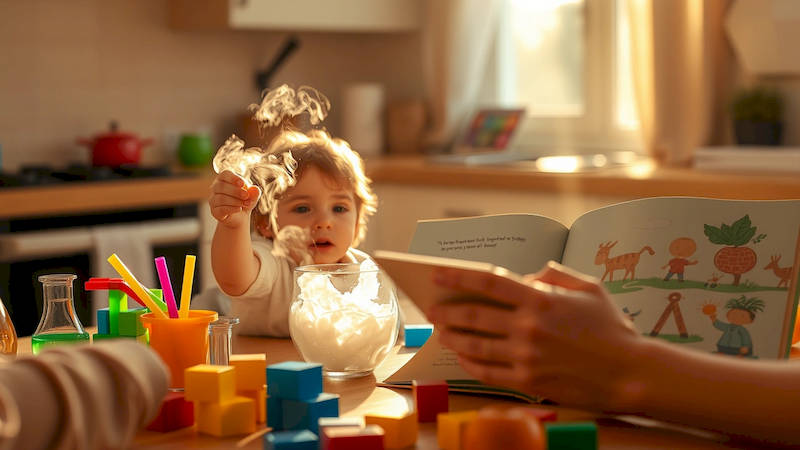
The world around us is a fascinating laboratory, brimming with opportunities for discovery. Yet, in our increasingly structured lives, many children are losing touch with the innate curiosity that drives scientific exploration. While formal science education is vital, fostering a love for STEM—Science, Technology, Engineering, and Mathematics—begins at home. Engaging children in simple, hands-on science experiments isn’t just about preparing them for future careers; it's about cultivating critical thinking, problem-solving skills, and a lifelong passion for learning. As Neil deGrasse Tyson eloquently put it, "The good thing about science is that it’s true whether or not you believe in it." This inherent truth and the joy of discovering it is what we want to instill in our children.
More than ever, STEM skills are becoming essential for navigating the complexities of the 21st century. A report by the U.S. Bureau of Labor Statistics projects that STEM occupations will grow 8.0 percent from 2022 to 2032, much faster than the average for all occupations. But beyond career prospects, science experiments help children develop persistence – experimentation often involves trial and error, teaching valuable lessons about resilience and the iterative nature of problem-solving. The goal isn’t to create mini-scientists performing complex research, but to nurture a mindset of questioning, observing, and understanding the world through investigation.
This article will guide you through creating impactful home science experiences, equipping you with resources, ideas, and insights to ignite your child’s scientific spark. We’ll delve into the principles of age-appropriate experimentation, safety considerations, and a range of accessible experiments that use everyday materials. Preparing for these engaging activities offers a fantastic way to bond with your children, enhancing their learning experience while making it memorable and enjoyable.
- The Foundation: Understanding Age-Appropriate Science
- Safety First: Creating a Secure Exploration Zone
- The Baking Soda & Vinegar Volcano: A Classic for a Reason
- Exploring Density: Floating and Sinking Adventures
- Building Simple Circuits: Illuminating the Power of Electricity
- Beyond the Basics: Resources to Fuel Continued Exploration
- Conclusion: Nurturing the Next Generation of Innovators
The Foundation: Understanding Age-Appropriate Science
When designing home science experiments, tailoring the complexity to your child's developmental stage is paramount. What captivates a preschooler will likely fall flat with a middle schooler - and vice versa. Younger children (ages 3-5) thrive on sensory experiences and simple cause-and-effect observations. Think about experiments involving color mixing, floating and sinking, or building simple structures. Their focus is on what happens, not necessarily why it happens, allowing them to develop foundational observation skills. The emphasis should be on exploration, using descriptive language and encouraging questions.
For children aged 6-8, incorporating basic scientific concepts becomes possible. Introduce simple variables – changing one thing at a time to see what effect it has. Baking soda and vinegar volcanoes, growing plants from seeds, or creating simple circuits are excellent choices. This age group is beginning to understand the idea of testing hypotheses, though you'll want to guide them through the process. Encourage them to predict what will happen before they conduct the experiment, and then to record their observations. Remember to encourage journaling by asking questions such as: What did you do first? What happened next? What did you observe?
Finally, older children (9-12+) can tackle more complex experiments with multiple variables and a deeper understanding of scientific principles. Building more elaborate structures, investigating chemical reactions, or designing their own experiments are suitable challenges. This is the age to introduce the scientific method explicitly – forming a hypothesis, designing an experiment, collecting data, analyzing results, and drawing conclusions. Focus on the why and how alongside the what, fostering a true scientific mindset.
Safety First: Creating a Secure Exploration Zone
The excitement of experimentation must always be balanced with a strong emphasis on safety. While home science experiments are generally low-risk, taking precautions is essential to prevent accidents and ensure a positive learning experience. Establish a designated workspace – a kitchen island, a garage table, or even a protected outdoor area. This zone should be well-lit, clean, and free from distractions. Before starting any experiment, discuss the specific safety rules with your child.
Key safety rules include wearing appropriate protective gear (safety glasses for experiments involving liquids or projectiles, gloves for handling chemicals, aprons to protect clothing), handling materials with care, and never tasting or smelling any substances without explicit permission. Always supervise children closely, especially when working with potentially hazardous materials like vinegar, baking soda, or heat sources. Keep a first-aid kit readily accessible, and know how to handle minor injuries. A critical aspect of safety is also proper disposal – ensure you understand how to safely dispose of any leftover materials used in the experiment. Resources such as the National Safety Council's website provide additional guidance on age-appropriate safety measures for science experiments.
The Baking Soda & Vinegar Volcano: A Classic for a Reason
The baking soda and vinegar volcano isn’t just a visually engaging experiment; it’s a fantastic introduction to chemical reactions, specifically acid-base reactions and the release of carbon dioxide gas. The materials are readily available in most kitchens – baking soda (sodium bicarbonate), vinegar (acetic acid), dish soap, food coloring (optional), and a plastic bottle. The basic procedure involves placing the bottle on a tray (to contain the 'lava'), adding a few tablespoons of baking soda, a squirt of dish soap, and a few drops of food coloring.
Then, slowly pour in vinegar – around ½ cup – and watch the eruption! The chemical reaction between the baking soda and vinegar creates carbon dioxide gas, which builds up pressure inside the bottle. The dish soap creates bubbles, making the eruption look more like lava. To further enhance the learning experience, discuss why the eruption happens, explaining the concept of acids and bases and the properties of gases. You can even vary the amount of baking soda or vinegar to see how it affects the eruption’s intensity – a great way to introduce the concept of variables.
Exploring Density: Floating and Sinking Adventures
Density is a fundamental scientific concept that explains why some objects float and others sink. This can be explored through a simple and engaging experiment using everyday objects. Gather a collection of items with varying densities, such as coins, corks, small plastic toys, apples, grapes, and different liquids like water, oil, and salt water. Start by asking your child to predict which objects will float and which will sink in plain water.
Next, systematically test each object and record the results. Discuss what it means for an object to be 'dense' and how that relates to its weight and volume. To take it a step further, create a salt water solution by dissolving salt in water. Demonstrate that objects that sank in plain water might float in salt water due to the increased density of the solution. This experiment visually illustrates how density affects buoyancy and introduces the concept of displacement. It’s a great way to demonstrate how seemingly complex scientific principles can be observed in the world around them.
Building Simple Circuits: Illuminating the Power of Electricity
Introduce your child to the basics of electricity and circuits with a hands-on building activity. You’ll need a battery (9-volt is a good starting point), a battery connector, a small light bulb, and some insulated wires. Connect one end of the battery connector to the positive terminal of the battery and the other end to one terminal of the light bulb. Then, connect a wire from the negative terminal of the battery to the other terminal of the light bulb.
If the circuit is complete, the light bulb will illuminate! Explain that electricity flows in a closed loop, and that the battery provides the energy source. Experiment with different configurations - what happens if you disconnect one wire? What happens if you add a switch to the circuit? This activity not only demonstrates the principles of electricity but also encourages problem-solving skills as your child troubleshoots the circuit. Always supervise this experiment closely, and emphasize the importance of never touching exposed wires.
Beyond the Basics: Resources to Fuel Continued Exploration
Once you’ve sparked your child’s interest in science, there are countless resources available to maintain that momentum. Websites like Science Buddies (sciencebuddies.org) offer a wealth of project ideas categorized by grade level and topic. The Exploratorium (exploratorium.edu) provides interactive online exhibits and educational resources. Libraries are also excellent sources of science books and experiment kits. Don’t underestimate the power of local museums and science centers – offering hands-on exhibits and workshops. Local universities or community colleges often host science outreach programs.
Consider joining a science club or encouraging your child to participate in science fairs. These provide opportunities for collaboration, mentorship, and showcasing their work. Tailor resources to your child’s specific interests – if they love space, focus on astronomy-related experiments and resources. If they’re fascinated by nature, explore the world of biology and ecology. The key is to make learning relevant and engaging, fostering a lifelong love for scientific exploration.
Conclusion: Nurturing the Next Generation of Innovators
Creating simple home science experiments is an incredibly powerful way to spark curiosity, foster critical thinking, and instill a love for STEM in children. Remember that the goal isn’t to create perfect scientists, but to cultivate a mindset of questioning, observing, and experimenting with the world around them. Prioritize safety, tailor the complexity to your child's age and developmental stage, and embrace the messiness and unforeseen results that often come with exploration.
By providing opportunities for hands-on learning, you’re not just preparing your child for future academic success; you're equipping them with the skills and passions to become innovative problem-solvers and engaged citizens. Start small, be patient, and most importantly, have fun! The most valuable takeaway is to view everyday life as a continuous learning opportunity, turning your home into a vibrant laboratory where curiosity thrives and the wonders of science are unveiled, one experiment at a time.
Deja una respuesta