
The Role of Outdoor Play in Enhancing Early Childhood Creativity
The early years of a child’s life – from infancy through age eight – are a period of unparalleled brain development. During this critical window, experiences shape neural pathways and lay the foundation for future learning, problem-solving, and, importantly, creativity. While structured educational activities have their place, mounting evidence shows that unstructured, outdoor play is not merely beneficial for children, but essential for fostering the kind of divergent thinking that fuels genuine creativity. In a world increasingly focused on standardized testing and measurable outcomes, prioritizing opportunities for free play in natural environments might seem counterintuitive, but it is a profound investment in our children’s potential. This article will delve into the multifaceted role outdoor play has in enhancing early childhood creativity, providing practical recommendations for parents and educators.
Often, creativity is mistakenly viewed as an inherent talent – something you either have or don’t. However, research in cognitive psychology demonstrates that creativity is a skill that can be nurtured and developed. Outdoor environments, with their inherent complexity, open-ended possibilities, and sensory richness, provide the perfect catalyst for this development. These spaces lack the rigid constraints of indoor settings, allowing children to explore, experiment, and invent without the fear of making mistakes. Ultimately, understanding and actively promoting outdoor play isn’t just about letting kids have fun; it's about strategically creating the conditions for their imaginations to flourish and their creative capacities to take root.
- The Neuroscience of Creativity and Outdoor Environments
- Loose Parts Play: Unleashing Imagination with Simple Materials
- The Impact of Risk and Challenge on Creative Growth
- Nature as a Storytelling Catalyst: Fostering Narrative Thinking
- The Role of Adults: Facilitating, Not Directing
- Beyond the Backyard: Integrating Nature into Everyday Life
The Neuroscience of Creativity and Outdoor Environments
The connection between outdoor play and creativity isn't just anecdotal; it's rooted in neuroscience. Exposure to natural settings has been demonstrably linked to improved cognitive function, reduced stress, and enhanced attention – all crucial components of creative thinking. Studies utilizing fMRI technology have shown that spending time in nature activates the prefrontal cortex, the area of the brain responsible for executive functions like planning, problem-solving, and, crucially, divergent thinking—the ability to generate multiple solutions to a single problem. A 2018 study published in Frontiers in Psychology demonstrated enhanced creative performance after participants engaged in a walk in a natural setting compared to an urban environment.
Outdoor environments challenge children’s senses in ways that indoor settings simply cannot. The constantly changing light, textures, sounds, and smells provide a rich sensory input that stimulates the brain and encourages exploration. This sensory engagement isn't passive; it demands that children actively interpret and respond to their surroundings, forcing them to think flexibly and adapt their strategies. Think of a child building a fort with branches and leaves - they're not just constructing a shelter; they are engaging in spatial reasoning, problem-solving, and imaginative play all at once, constantly adjusting to the unique characteristics of the materials they're using. This improvisation is at the heart of creativity.
Furthermore, the unstructured nature of outdoor play minimizes the pressure to conform to predetermined outcomes. Unlike many structured activities with defined rules and expectations, outdoor play allows children to follow their own curiosity and interests, leading to self-directed exploration and a greater sense of agency. This sense of autonomy is crucial for developing intrinsic motivation, a key driver of creative expression. Children are more likely to take risks, experiment with new ideas, and persist in the face of challenges when they feel empowered to direct their own learning.
Loose Parts Play: Unleashing Imagination with Simple Materials
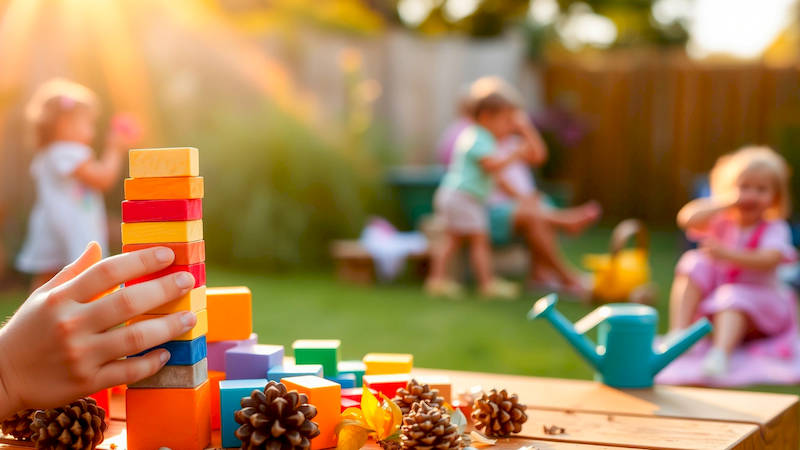
"Loose parts play" is a powerful methodology for fostering creativity in outdoor settings, and it's incredibly simple to implement. This approach centers around providing children with a diverse collection of open-ended materials – natural and manufactured – that can be manipulated, combined, and transformed in countless ways. Examples include sticks, stones, pinecones, leaves, fabric scraps, wooden blocks, pots, pans, and even recycled materials like cardboard boxes and plastic bottles. The key is that these materials have no single, predetermined function.
The beauty of loose parts lies in their ambiguity. A stick isn’t just a stick; it can be a magic wand, a building support, a paintbrush, or a bridge. A pile of stones isn't just a pile of stones; it's a potential castle, a road, or a collection of treasures. This open-endedness forces children to think creatively and come up with their own uses for the materials. Educators like Lisa Daly have championed loose parts play, arguing that it encourages “thinking outside the box” and fosters a sense of wonder and exploration. Daly’s work emphasizes that the value isn't in what the children create, but in how they use the materials and the thought processes they engage in.
Implementing loose parts play doesn't require expensive equipment or elaborate planning. Start small by gathering a collection of natural materials from your backyard or a nearby park. Observe how children interact with the materials and resist the urge to direct their play. Instead, offer gentle encouragement and provide opportunities for them to collaborate and share ideas. Be mindful of safety and ensure that materials are age-appropriate and free of hazards.
The Impact of Risk and Challenge on Creative Growth
While safety is paramount, it’s also crucial to recognize the importance of allowing children to experience manageable risks in their outdoor play. The modern tendency to overprotect children can inadvertently stifle their creativity by limiting opportunities for exploration and experimentation. Climbing trees (with appropriate supervision), building dams in streams, and even navigating uneven terrain all involve a degree of risk, but these challenges also encourage children to assess situations, problem-solve, and develop resilience.
These experiences are not just about physical development; they also build confidence and a sense of mastery. When children successfully overcome a challenge, they develop a belief in their own abilities, which is essential for taking creative risks. The fear of failure can be a significant barrier to creativity, preventing children from trying new things or expressing unconventional ideas. Allowing children to experience age-appropriate risks helps them to overcome this fear and embrace the possibility of making mistakes.
Consider a child attempting to build a tower out of rocks on a slightly uneven surface. They may have to adjust their design, experiment with different placements, and even accept that the tower may fall down at times. This process of trial and error, and the lessons learned from failure, are invaluable for developing creative problem-solving skills. Instead of intervening to prevent the tower from falling, a supportive adult can offer encouragement and help the child reflect on what went wrong and how they might approach the challenge differently next time.
Nature as a Storytelling Catalyst: Fostering Narrative Thinking
Outdoor environments are inherently rich in narrative potential. A gnarled tree can become a wise old wizard, a patch of moss a magical fairy garden, and a babbling brook a pirate ship sailing to distant lands. This natural storytelling catalyst encourages children to develop their imaginations, articulate their ideas, and construct their own narratives.
Encourage this process by asking open-ended questions: "What do you think this tree has seen?" "If this rock could talk, what would it say?" "What kind of creatures might live in this pond?" Avoid imposing your own interpretations and instead allow children to lead the storytelling process. Provide props like blankets, hats, or small toys to help them bring their stories to life.
This type of imaginative play is not just about having fun; it also promotes language development, social-emotional skills, and critical thinking. As children create and share their stories, they learn to communicate effectively, empathize with others, and understand different perspectives. They’re also practicing the core skill of world-building, essential for innovative thinking in any field.
The Role of Adults: Facilitating, Not Directing
It's tempting for adults to want to "teach" creativity, but the most effective approach is to facilitate it. This means providing opportunities for unstructured play, offering encouragement, and creating a supportive environment, but avoiding the urge to direct the process or impose your own ideas. Resist the temptation to tell children what to build, how to play, or what to imagine.
Instead, act as a co-player, joining in their games and offering suggestions only when invited. Ask open-ended questions that encourage them to think critically and explore their own ideas. Be a good observer, paying attention to their interests and providing materials that support their explorations. Perhaps the most important thing an adult can do is to model creative thinking themselves, demonstrating a willingness to experiment, take risks, and embrace the unexpected.
This transition from "director" to "facilitator" can be challenging for adults accustomed to traditional teaching methods. However, it's a crucial shift in mindset that allows children to take ownership of their own learning and develop their creative potential to the fullest. Remember, the goal isn’t to create “artists” or “inventors,” but to nurture a lifelong love of learning and a willingness to think outside the box.
Beyond the Backyard: Integrating Nature into Everyday Life
While access to expansive natural spaces is ideal, it's not always feasible. The principles of outdoor play can be integrated into everyday life, even in urban environments. Parks, community gardens, and even small patches of green space can provide valuable opportunities for children to connect with nature.
Look for ways to bring natural elements into indoor spaces as well. Plants, flowers, stones, and shells can all add a touch of the outdoors to a child's room or playroom. Encourage children to collect natural materials during walks and use them in art projects or imaginative play. Even a simple nature table can spark curiosity and inspire creativity.
The key is to be intentional about creating opportunities for children to experience the sights, sounds, smells, and textures of nature, regardless of their surroundings. Remember, even small doses of nature can have a significant impact on a child's well-being and creative development.
In conclusion, the role of outdoor play in enhancing early childhood creativity is undeniable. From the neurological benefits of natural environments to the power of loose parts play and the importance of manageable risk, each aspect contributes to the development of a flexible, imaginative mind. By prioritizing unstructured play in nature and acting as facilitators rather than directors, parents and educators can nurture the creative spark within each child, equipping them with the skills and confidence they need to thrive in an ever-changing world. The takeaway is simple: less screen time, more green time. Invest in your children’s creative future, and let them bloom in the great outdoors.
Deja una respuesta