
Simple Physics Projects to Explore Motion and Forces with Kids
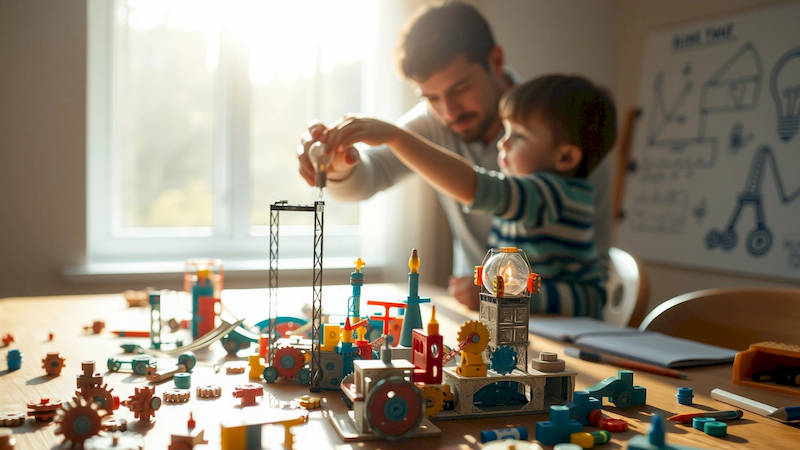
The world around us is governed by physics, the fundamental science that explains how things move and interact. Often, this complex field feels distant and abstract, but it's actually readily observable in everyday life. Introducing physics concepts to children early on isn’t about creating future physicists (though that would be a delightful outcome!); it's about fostering critical thinking, problem-solving skills, and a deeper appreciation for how the world works. These skills lay a foundation for success not just in STEM fields, but in any discipline.
Early exposure to STEM (Science, Technology, Engineering, and Mathematics) is increasingly recognized as crucial for preparing children for the future workforce. According to the U.S. Bureau of Labor Statistics, STEM occupations are projected to grow 10.8 percent from 2022 to 2032, much faster than the average for all occupations. More fundamentally, understanding basic physics provides a framework for understanding cause and effect, predicting outcomes, and making informed decisions – skills invaluable in all aspects of life. This article will explore several simple, engaging physics projects families can undertake to explore the fascinating worlds of motion and forces.
- The Power of Prediction: Exploring Inertia with a Tablecloth Pull
- Building Bridges to Understanding: Forces in Structures
- Gravity’s Pull: Ramp Races and Exploring Potential & Kinetic Energy
- The Momentum Machine: Egg Drop Challenges and Impact Forces
- Air Resistance Adventures: Parachute Design and Terminal Velocity
- Conclusion: Fostering a Lifelong Love of Learning
The Power of Prediction: Exploring Inertia with a Tablecloth Pull
Inertia, the tendency of an object to resist changes in its state of motion, is a cornerstone concept in physics. It can often feel counterintuitive, but a simple tablecloth pull dramatically demonstrates this principle. Many children believe that if you quickly pull a tablecloth from under dishes, the dishes will fall. However, if done correctly, they remain relatively stationary! This happens because the dishes, at rest, want to stay at rest. A quick pull minimizes the force applied to the dishes, not giving them enough time to accelerate downwards with the tablecloth.
To conduct this experiment, you’ll need a smooth table, a non-slip tablecloth, and several lightweight, stable dishes (plastic is recommended for safety!). Place the dishes near the edge of the tablecloth, ensuring they're spaced out. The key is the pull – it must be quick and horizontal. Practice without dishes first to get a feel for the motion. Explain to your child before the pull that the dishes will likely stay put if you do it correctly, encouraging them to predict the outcome. This fosters the scientific method of hypothesizing, experimenting, and observing.
This project isn’t just about the ‘magic’ of floating dishes. It’s a gateway to discussing further concepts. Ask questions like: “What if the dishes were heavier?” or “What if you pulled the tablecloth more slowly?”. Discuss how friction between the tablecloth and dishes plays a role, and how reducing this friction makes the experiment work. Real-world parallels include car safety – seatbelts work by counteracting inertia, stopping passengers from continuing forward in motion during a sudden stop.
Building Bridges to Understanding: Forces in Structures
Exploring forces acting on structures is another tangible way to bring physics to life. A simple bridge-building challenge provides a fantastic hands-on learning opportunity. This activity encourages children to think about compression (a pushing force) and tension (a pulling force) and how these forces affect the stability of a structure. Consider using readily available materials like spaghetti, marshmallows, toothpicks, or even LEGOs.
Challenge your child to build a bridge that can support a certain weight – start small with a book or a small toy car, then gradually increase the load. Encourage them to experiment with different designs: arches, trusses, and beams. As they build, ask questions like “What happens if you change the shape of the bridge?” or “Where do you think the strongest parts of the bridge are?”. Let them identify the weakest points through testing – this is a crucial part of the learning process.
Introduce concepts like load distribution. Explain how arches distribute weight more evenly than simple beams, making them stronger. Discuss real-world examples like the Golden Gate Bridge or Roman aqueducts, highlighting how engineers use these principles to create stable and durable structures. This project also subtly introduces engineering design principles – iterative improvement and problem-solving through experimentation.
Gravity’s Pull: Ramp Races and Exploring Potential & Kinetic Energy
Gravity affects everything around us, but it’s often an invisible force. Ramp races offer a playful way to demonstrate gravity’s pull and introduce the concepts of potential and kinetic energy. All you need is a smooth surface, a ramp (a piece of wood, cardboard, or even a book inclined at an angle), and various objects to roll down the ramp—balls, toy cars, marbles, or small blocks.
The experiment begins by having your child predict which object will travel the farthest. Discuss why they think that object will be faster – introducing the idea that different masses and shapes affect movement. As the objects roll, talk about potential energy (the energy stored at the top of the ramp) and kinetic energy (the energy of motion as the object rolls down). Explain how potential energy is converted into kinetic energy as the object descends. Vary the height of the ramp and observe the impact on speed and distance.
To take this experiment further, introduce different surface textures at the bottom of the ramp – carpet, smooth wood, rough concrete. Discuss how friction affects the distance traveled by the objects. Ask: "What happens if the ramp is steeper?". This project seamlessly blends physics with observation and prediction, reinforcing the notion that scientific concepts are not isolated but interconnected.
The Momentum Machine: Egg Drop Challenges and Impact Forces
The egg drop challenge is a classic physics experiment for a reason – it’s engaging, dramatic, and teaches valuable lessons about momentum and impact forces. The goal? Design a contraption that will protect a raw egg from breaking when dropped from a predetermined height. This necessitates understanding how to slow down the rate of deceleration, reducing the force of impact.
The materials are open-ended, encouraging creativity and problem-solving. Common choices include cardboard, bubble wrap, straws, cotton balls, and tape. Discuss with your child the factors that contribute to a safe landing: absorbing the impact, distributing the force over a larger area, and increasing the time it takes for the egg to come to a stop. Explain that momentum – the mass of an object multiplied by its velocity – is a key factor. The greater the momentum, the greater the force needed to stop it.
Successful egg drop designs often incorporate energy-absorbing materials and structures that distribute the force of impact over a larger area. This project truly puts physics principles into practice, demanding thoughtful design and testing. It’s okay if the egg breaks – even failures are learning opportunities! Analyze why the egg broke and how the design could be improved.
Air Resistance Adventures: Parachute Design and Terminal Velocity
Air resistance, or drag, is another force that often gets overlooked but profoundly impacts the motion of objects. Building and testing parachutes provides a fun and visually engaging way to explore this concept. Basic materials include a plastic bag, string, and a small weight (a toy figure or a few coins).
Start with a simple design and experiment with different sizes and shapes of parachutes. Discuss how the surface area of the parachute affects its descent speed. A larger parachute has more surface area, creating more air resistance, resulting in a slower descent. Introduce the concept of terminal velocity – the constant speed that a falling object eventually reaches when the force of air resistance equals the force of gravity.
Encourage your child to design variations – adding holes, using different materials, or changing the shape of the parachute. Compare and contrast the performance of each design. This project is a great way to connect physics to real-world applications like skydiving and space exploration. Discuss how parachutes are used to slow down astronauts returning to Earth or to deliver supplies safely.
Conclusion: Fostering a Lifelong Love of Learning
Exploring motion and forces with simple physics projects isn't about creating a generation of scientists; it's about nurturing curiosity, critical thinking, and problem-solving skills. These are the building blocks for success in any field. The projects outlined above – from the tablecloth pull to the egg drop challenge – demonstrate that physics isn't a complex, abstract subject, but a tangible part of our everyday world.
The key takeaway is to embrace experimentation and failure as learning opportunities. Encourage your child to ask ‘why’ questions, make predictions, and test their ideas. These hands-on experiences foster a deeper understanding of scientific concepts and ignite a lifelong love of learning. Start small, be patient, and, most importantly, have fun. Consider expanding these explorations by visiting science museums, reading age-appropriate science books, and encouraging your child’s natural curiosity about the world around them. The seeds of scientific inquiry planted today can blossom into a future filled with innovation and discovery.
Deja una respuesta