
Using Art Projects to Teach Colors, Shapes, and Patterns in Early Learning
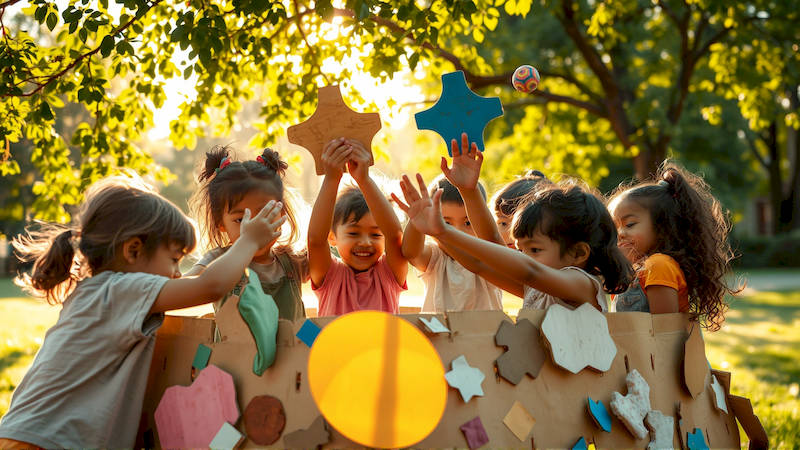
For parents and educators of young children, the early years represent a period of incredible cognitive growth and development. During this time, foundational concepts like colors, shapes, and patterns are crucial building blocks for future learning in mathematics, reading, and even social-emotional understanding. While traditional methods like flashcards and worksheets have their place, integrating these concepts into art projects offers a uniquely engaging and effective approach. Art taps into a child's natural curiosity and creativity, fostering a deeper understanding that goes beyond rote memorization. It moves beyond simply recognizing a shape to understanding its characteristics and how it relates to the world around them.
This approach isn’t merely about producing beautiful artwork; it’s about facilitating learning through hands-on experiences. When children manipulate materials, experiment with colors, and construct patterns, they're actively involved in the learning process. This active engagement promotes better retention and a more intuitive grasp of the concepts. Moreover, art projects encourage problem-solving, critical thinking, and self-expression – skills that are vital for success in all areas of life.
The beauty of using art lies in its adaptability. Activities can be tailored to suit different age groups and learning styles, ensuring every child has the opportunity to thrive. From toddlers exploring primary colors with finger paints to preschoolers creating intricate shape collages, art provides a flexible and compelling framework for early learning. This article explores specific techniques, project ideas, and best practices for effectively integrating color, shape, and pattern instruction into art experiences for young learners.
- Understanding the Developmental Stages & Art Integration
- Color Exploration Through Painting and Mixed Media
- Decoding Shapes: From Recognition to Construction
- Patterning with Art: Building Mathematical Foundations
- Layering Complexity: Combining Colors, Shapes, and Patterns
- Adapting for Diverse Learners and Accessibility
- Conclusion: Cultivating a Love of Learning Through Art
Understanding the Developmental Stages & Art Integration
Integrating art with early learning necessitates acknowledging the developmental stages of children. A two-year-old's understanding of color differs vastly from a five-year-old’s. Initially, children are primarily focused on the sensory experience of art – the feel of the paint, the texture of the paper. Color recognition begins with basic distinctions (like “red” and “blue”) but progresses to shades and variations. Shape understanding moves from recognizing whole shapes to understanding their properties – number of sides, corners, etc. Pattern recognition emerges similarly, starting with simple AB patterns and evolving to more complex sequences.
When planning art projects, it’s vital to align the complexity with the child's developmental stage. For younger toddlers (18-24 months), focus on color exploration with large-format painting or crayon scribbling. Introduce shapes through simple sorting activities using pre-cut shapes or encouraging shape identification during play. Patterns can be introduced through basic bead stringing or block arrangements. As children mature (3-5 years), projects can become more complex, incorporating activities like shape collages, color mixing experiments, and creating their own patterned designs. Don’t underestimate the power of open-ended art; allowing children to explore freely within defined parameters fosters creativity and deeper learning.
A key aspect of this integration is intentionally asking guiding questions during the art process. Instead of simply praising the finished product, ask "What colors did you use?" or "Can you point to all the triangles in your picture?". This prompts children to actively think about the concepts being reinforced. Furthermore, celebrate the process not just the product; encourage experimentation and exploration, valuing effort and creativity over perfectly executed artwork. According to Dr. Laura Berk, a prominent child development expert, "Play, and particularly art-based play, allows children to construct knowledge and understanding through active exploration and manipulation of their environment.”
Color Exploration Through Painting and Mixed Media
Painting offers a remarkably versatile medium for teaching colors. Start with primary colors—red, yellow, and blue—allowing children to freely experiment with mixing them to create secondary colors (orange, green, purple). This hands-on experience demystifies the concept of color mixing, making it more understandable than simply explaining it. Provide opportunities to paint with different tools – brushes, sponges, cotton swabs, even fingers – to enhance sensory exploration and develop fine motor skills.
Beyond simple color mixing, explore color theory concepts like warm and cool colors. Have children create paintings representing different seasons, using warm colors (reds, oranges, yellows) to depict summer and autumn, and cool colors (blues, greens, purples) to represent winter and spring. Incorporate mixed media elements like collage, incorporating colored paper, fabric scraps, or natural materials to expand the color palette and add texture. Encourage children to create color gradients or ombre effects, demonstrating subtle variations within a single hue.
Consider a "color hunt" activity where children search for objects around the classroom or home that match specific colors. Then, they can recreate those objects in their artwork, further solidifying their association between color names and real-world examples. Resist the urge to correct “incorrect” color choices; allow children to express their perceptions and preferences. For example, a child painting a horse purple may simply be expressing their imaginative vision! This exploration fosters creativity and a broader understanding of color as a form of expression.
Decoding Shapes: From Recognition to Construction
Teaching shapes effectively moves beyond simple identification. It's about understanding the attributes of each shape – number of sides, angles, vertices – and how those attributes contribute to their function and appearance. Start with basic shapes – circle, square, triangle, rectangle – and introduce them through various art projects. For instance, have children create collages using pre-cut shapes, encouraging them to name each shape and discuss its characteristics as they glue them onto the paper.
Progress to shape construction activities. Provide children with materials like straws and playdough, toothpicks and marshmallows, or even building blocks, and challenge them to build various shapes. This hands-on activity reinforces the understanding of shape properties and spatial reasoning skills. Introduce more complex shapes – hexagons, octagons, pentagons – as children progress. Create a "shape scavenger hunt" where children search for shapes in the environment, identifying them in everyday objects.
A powerful extension activity is to encourage children to combine shapes to create pictures. For example, a house can be constructed from a square (body), a triangle (roof), and a circle (sun). This not only reinforces shape recognition but also fosters creativity and problem-solving skills. It demonstrates how simple shapes can be used as building blocks for more complex representations.
Patterning with Art: Building Mathematical Foundations
Pattern recognition is a fundamental mathematical skill that lays the groundwork for algebra and problem-solving. Art provides a uniquely visual and engaging way to develop this skill. Start with simple AB patterns – red, blue, red, blue – using various art media like beads, paint, or blocks. Have children create their own AB patterns using different colors, shapes, or textures. Gradually introduce more complex patterns – AAB, ABB, ABC – challenging children to predict and extend the sequence.
Introduce the concept of repeating patterns through art projects like creating patterned bracelets or designing wallpaper. Provide children with stamps, stencils, or pre-cut shapes and encourage them to create repeating patterns on paper or fabric. Explore symmetrical patterns by folding paper in half and creating designs on one side, which are then mirrored on the other. This introduces the concept of symmetry and its mathematical principles.
Furthermore, discuss real-world examples of patterns – stripes on a zebra, petals on a flower, bricks in a wall. This helps children recognize the ubiquity of patterns in their environment and understand their practical applications. Encourage children to create their own artistic representations of these patterns, reinforcing their understanding and fostering creativity.
Layering Complexity: Combining Colors, Shapes, and Patterns
Once children have a solid understanding of individual concepts, it’s time to integrate them. Challenge them to create artwork that incorporates all three – colors, shapes, and patterns. For example, ask them to create a landscape painting using different shapes, repeating patterns, and a specific color scheme. Provide guidelines like “Create a picture of a town using only squares, rectangles, and triangles, and using warm colors”.
Introduce activities like creating mandalas, which require meticulous attention to detail and the integration of symmetry, shapes, and repeating patterns. Encourage children to design their own patterned textiles, incorporating different colors, shapes, and repeating motifs. These projects necessitate critical thinking, problem-solving, and artistic expression. Exploring artists like Piet Mondrian, known for his abstract compositions utilizing primary colors and geometric shapes, can further inspire children's creativity.
It's crucial to provide scaffolding and support throughout this integration process. Offer examples and guidance, but avoid imposing rigid constraints. The goal is to encourage children to explore their creativity while reinforcing their understanding of the core concepts.
Adapting for Diverse Learners and Accessibility
Effective implementation requires recognizing diverse learning needs. For children with visual impairments, focus on textures and tactile exploration. Use raised-line drawings or three-dimensional shapes to help them understand shapes. For children with fine motor challenges, provide adapted art tools – thicker brushes, larger crayons, or assistive technology. For children who struggle with pattern recognition, start with very simple patterns and gradually increase complexity.
Consider incorporating visual aids like color charts, shape posters, and pattern cards to support learning. Provide verbal cues and prompts to help children articulate their understanding. Create a supportive and inclusive learning environment where all children feel comfortable experimenting and expressing themselves. Personalizing projects to reflect children's individual interests and cultural backgrounds can also enhance engagement and motivation. As stated by Howard Gardner in his Theory of Multiple Intelligences, catering to different learning styles maximizes comprehension and retention.
Conclusion: Cultivating a Love of Learning Through Art
Integrating art into early learning is not just about imparting knowledge of colors, shapes, and patterns; it's about fostering a love of learning, nurturing creativity, and developing essential cognitive skills. By leveraging children’s natural curiosity and providing hands-on experiences, we can create a dynamic and engaging learning environment where they thrive. Remembering to align activities to developmental stages, and prioritizing process over product, will ensure meaningful engagement.
The key takeaways are clear: actively engage children in artistic exploration, guide their learning through intentional questioning, and adapt activities to meet individual needs. Encourage experimentation and celebrate creativity, and remember that art is a powerful tool for unlocking a child’s full potential. Move beyond passive recognition and delve into active creation. As a next step, brainstorm a series of art projects tailored to your child’s age and interests, focusing on one concept at a time, and then gradually layering complexity. Embrace the mess, celebrate the moments of discovery, and watch as your child's confidence and skills blossom.
Deja una respuesta